 Image 1 of 1
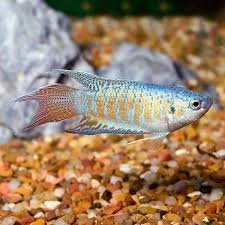
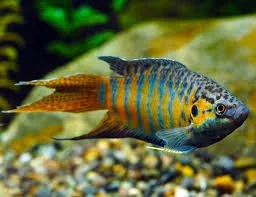
The Blue Paradise Gourami, or Paradise Fish, is a vibrant, freshwater fish known for its striking teal and orange vertical stripes, which intensify with age and in males. These fish are omnivores, grow to about 4 inches, and are a type of labyrinth fish, meaning they breathe air directly from the surface. Due to their territorial and often aggressive nature, especially with other males or smaller fish, they require a large aquarium with hiding spots and should be housed with compatible, larger tank mates or kept alone.
Physical description
Coloration: Features alternating teal and orange stripes on a typically blue body.
Fins: The fins, especially the tail, are often more orange and can have a "feather-like" appearance.
Size: Fully grown, they typically reach about 4 inches in length.
Male vs. Female: Males are generally more brightly colored and have longer, more elaborate fins than females.
Behavior and temperament
Aggression: Blue Paradise Gouramis are territorial and can be aggressive, especially males towards other males or smaller fish.
Compatibility: They are not ideal for a community tank with small or delicate fish, as they may be attacked or attacked by other fish.
Tank Mates: Should be housed with larger, robust fish or kept in solitary confinement to avoid conflict.
Unique traits
Labyrinth fish: They have a special organ that allows them to breathe air directly from the surface, so they need access to the water's surface.
Jumping: Blue Paradise Gouramis are known to be jumpers, so a tight-fitting lid is essential to prevent them from escaping.
Color change: They can change color based on their mood and surroundings.
Care and needs
Tank size: An established tank of at least 30 gallons is recommended.
Aquascaping: The aquarium should include dense plants and hiding places.
Diet: As omnivores, they thrive on a diet of quality flake foods, supplemented with protein-rich foods like bloodworms, brine shrimp, and insects.
Water parameters: They prefer warm water (72-80 °F) and are adaptable to various water conditions.
The Blue Paradise Gourami, or Paradise Fish, is a vibrant, freshwater fish known for its striking teal and orange vertical stripes, which intensify with age and in males. These fish are omnivores, grow to about 4 inches, and are a type of labyrinth fish, meaning they breathe air directly from the surface. Due to their territorial and often aggressive nature, especially with other males or smaller fish, they require a large aquarium with hiding spots and should be housed with compatible, larger tank mates or kept alone.
Physical description
Coloration: Features alternating teal and orange stripes on a typically blue body.
Fins: The fins, especially the tail, are often more orange and can have a "feather-like" appearance.
Size: Fully grown, they typically reach about 4 inches in length.
Male vs. Female: Males are generally more brightly colored and have longer, more elaborate fins than females.
Behavior and temperament
Aggression: Blue Paradise Gouramis are territorial and can be aggressive, especially males towards other males or smaller fish.
Compatibility: They are not ideal for a community tank with small or delicate fish, as they may be attacked or attacked by other fish.
Tank Mates: Should be housed with larger, robust fish or kept in solitary confinement to avoid conflict.
Unique traits
Labyrinth fish: They have a special organ that allows them to breathe air directly from the surface, so they need access to the water's surface.
Jumping: Blue Paradise Gouramis are known to be jumpers, so a tight-fitting lid is essential to prevent them from escaping.
Color change: They can change color based on their mood and surroundings.
Care and needs
Tank size: An established tank of at least 30 gallons is recommended.
Aquascaping: The aquarium should include dense plants and hiding places.
Diet: As omnivores, they thrive on a diet of quality flake foods, supplemented with protein-rich foods like bloodworms, brine shrimp, and insects.
Water parameters: They prefer warm water (72-80 °F) and are adaptable to various water conditions.